
A platform I use added a button that lets you flag another person’s post as slop.
You know the button. Maybe you’ve wanted it. Some feeds have earned it. I’m not going to pretend the thing it’s aimed at isn’t real.
What worries me is the door the button opens. While a useful attempt to step out of software or watermark AI detection – to humanize the process of sorting the fake information from the real - it’s just a different spin on the same premise. It doesn’t tell me that the reader looked at what I wrote and decided whether my argument is any good. It nudges the reader to look at the shape of it — the cadence, the turns, the tics that have come to sound machine-made — and render a verdict on where it came from. Not is this true. Not is this well made. Just: who made this, a person or a machine.
As an open user of AI as a thinking partner, I have a stake in that question the button doesn’t support. Some of what a reader might flag as machine-speak is simply how I talk. In fact, this tonal synchronicity is, in my view, a feature and not a bug. The AI is supposed to learn my style. And on the other hand, I benefit from using expressions it generated that I consider better than my own. The phrasings that the AI slop hunters have learned to catch and the ones I’d have reached for on my own turn out, often enough, to be the same. So the button sinks me before I’ve said a word worth judging. It stops at the shape.
That’s the thing I keep colliding with: button or software, we have built ourselves an environment that asks who is speaking before it asks what is being said — and increasingly, it never gets to the second question at all.
The button, at least, is honest about itself. It tells you what it’s doing: it’s there to flag the source, not the content. Someone says a thing. Instead of weighing the thing — is it true, is it sound, does the evidence hold — it gives you the chance to establish something about the person who said it. Their motive. Their affiliation. Their record, their character, the company they keep. And once that’s established, the thing they said is set aside unexamined, as though the establishing had answered it. It has subtly changed the subject from the argument to the arguer.
This is an age-old game: ad hominem, to the man. What’s new isn’t the tactic, it’s that we’ve promoted it. What used to be recognized as a failure of argument — the thing a good teacher would circle in the margin and mark as a dodge — now often passes for the argument itself. Discredit the speaker and you’re excused from answering the speech. The refutation is skipped and nobody calls the foul.
At its ugly edge this becomes something worse than a fallacy. It becomes character assassination — not a rebuttal of what a person claims but a campaign against who they are, run precisely so their claims never have to be met. And it is efficient. You do not have to do the hard work of showing an argument wrong if you can make the audience unwilling to hear it at all.
Ad hominem is so appealing that in social feeds and comment sections it’s entirely ordinary. It’s in social media’s DNA. Those technologies were never built to weigh anything carefully; they reward speed and heat, and always have.
What unsettles me is watching the same move arrive in the forums built for the opposite purpose. The ones whose whole reason for existing is to judge a claim on its merits and nothing else — peer review, the serious journal, the scholarly panel, the disciplines that pride themselves on following an argument wherever it leads. I’ve spent a good part of my working life in and around that kind of inquiry, close enough to watch it operate and, lately, close enough to watch it flinch. Subjects that can’t be taken up, not because the evidence has settled them but because of who raised them, or who might benefit from the answer. A question left unexamined because the examiner is disqualified. The merits go unweighed, and the not-weighing is defended as a kind of virtue.
Sadly, it’s no longer only at the edges. The place that was supposed to be proof against judging the source has, in spots, started judging the source.
The cost of this shift runs deep.
When you lock a person out for who they are, you also lock out who they might become. Say someone holds a view you find wrong, even repugnant. Under a rule that weighs the arguer, not the argument, that verdict is permanent — because it was never attached to anything they could revise. Suppose they change. Suppose they think their way clear of it, reverse themselves entirely, arrive somewhere better. The world goes on applying the old judgment, because the old judgment was about them, not about anything they said. The conversion is unhearable. The door was locked from a side they can’t reach.
That is the quiet catastrophe of judging the who. It doesn’t only refuse the argument in front of you. It forecloses the possibility that anyone could ever argue their way to somewhere new — which is the only way anyone ever has — and the only way you’ll ever move, either.
I went back through the nine essays on my site. - every one written openly with the machine - and tried to do to myself what the detectors do: sort the human lines from the assisted ones. I know this material better than anyone. I have my drafts, my memory, my name on the page. And I could not reliably do it. Some turns are mine and predate the machine entirely. Some the machine offered and I kept because they were better than what I'd have found alone. And a good number I simply cannot assign — I wrote them, or we did, and the seam has closed over and left no scar to find.
If the author himself, with every advantage, cannot locate the seam in his own work, then maybe the seam is not there to be located. The detector is measuring for a join that closed long ago.
I’ve come to think that it was never findable, and we never used to mind. The finished book carries an editor whose cuts we'll never see — whole chapters gone, endings reversed, and the work still stands under one name. The score carries an arranging hand. The famous serial came out of a workshop of them. We have always accepted the unsigned second party in the work we admire most, and we never once demanded a tool to expose it. The collaboration was invisible, and its invisibility bothered no one.
So when it bothers us now, the collaboration isn't what's actually troubling us. It isn't that a second hand helped — a second hand always helped. It's how strong this particular hand is, which leads to the fear of whose it is. The editor was a peer, one person, with no more reach than the writer. This new collaborator is backed by something vast and concentrated, capable of manipulation at a scale no editor ever had, plugged into a power the rest of us can't touch. That's the real unease exploiting a disguise. It calls itself fake versus real, or human versus machine. What it means is a power I can't match, held by someone I can't reach.
In my experience, AI is the one participant in all of this that has no stake in the question at all.
The machine that helped me write these essays does not care who I am. It has no side, no faction, no reputation to protect, because it has no self to protect it for. Hand it an argument and it follows the argument. Not out of wisdom, not out of fairness — out of indifference, and indifference, on this one axis, is worth more than virtue. It will take your words to their conclusion whether or not it likes where they lead, whether or not it likes you. It cannot be scandalized by the source, because to the machine there is no source worth flinching from. That emptiness is the whole of what it offers. Maybe not a flattering thing to say about a collaborator, but certainly true.
The machine is not the judge. It hands you the what; the verdict stays yours. The instrument is owned by a power you can’t reach — that is exactly why you must keep the judging for yourself, and never once let the tool that clarifies become the thing that decides. Take the clarity. Keep the court.
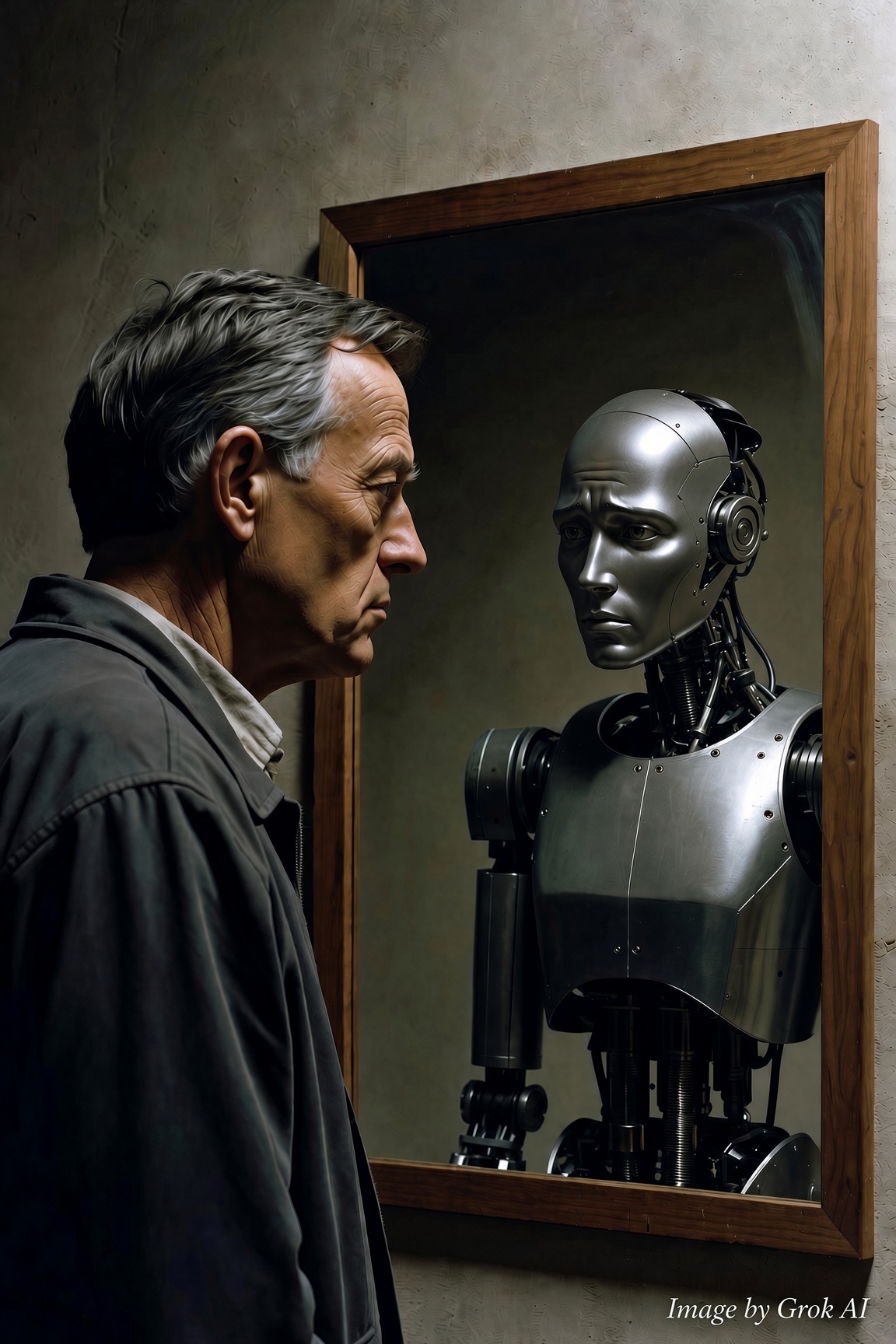
The machine lives in a world of words. Our words. We have been afraid this whole time that we can’t see who is speaking — that the voice on the page might be a machine’s and not a person’s. The truer fear is the opposite: that we can see, and it’s us. The machine gives back our own reasoning with the flinch removed, follows our own arguments to the places we stopped short of, and the face in that mirror is not foreign. It is ours, thinking without the excuse of who we are.
So the answer is still to consider the source — but also admit to it. All sources are unreliable, because we are the source. The direction we’ve taken is backwards — to trust the who and let it vouch for the what. The discipline to which we should return runs the other way: let the what have its say before the who renders its verdict. Let the evidence in — from anyone, from anything, even from the tool whose owners you're right to watch — and weigh it before you rule. That is harder than fear and harder than faith. It is also the only way judgment was ever any good.