
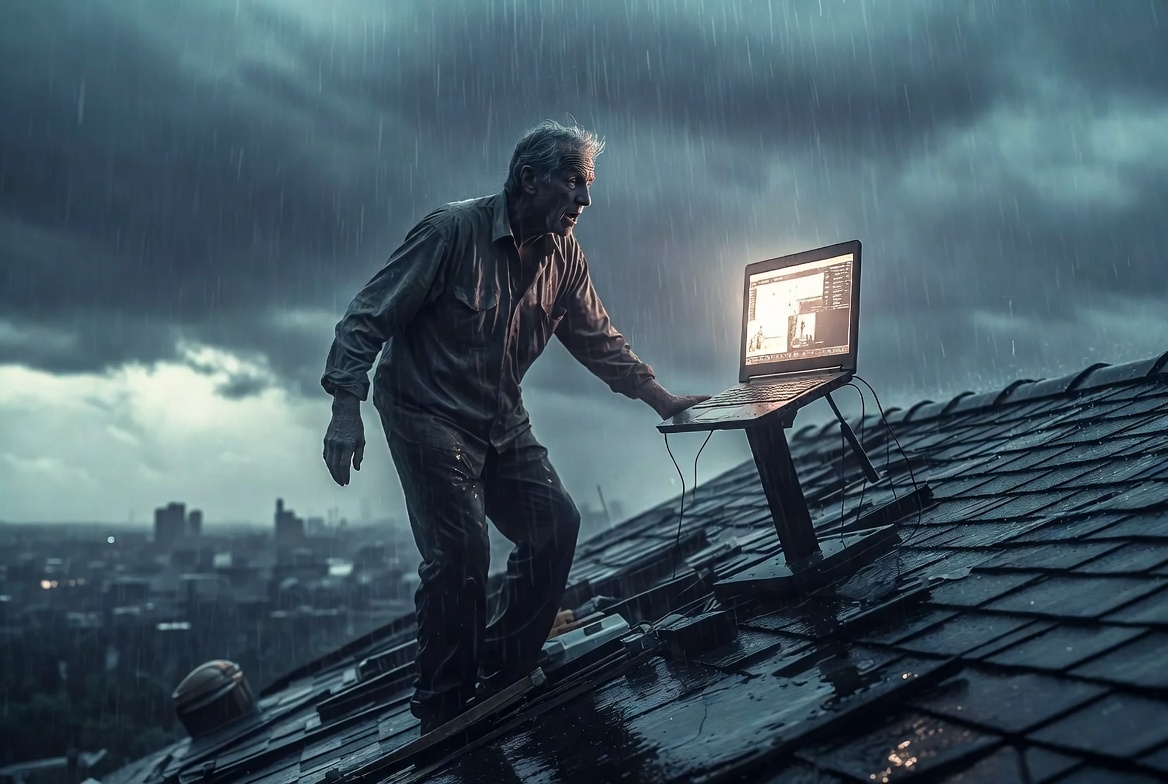
There is a video that will tell me how to fix a problem with my roof. I know this because I am on the roof, in the rain, watching it.
The laptop is balanced on the slope beside me, screen going silver every time the wind throws water across it, the keyboard threatening to short out any second. The man in the video knows exactly what he’s doing. He is in no hurry to tell me. He has greeted his viewers, thanked them for coming back, reminded them to subscribe, and is now explaining the history of the kind of flashing I have, while the actual rain comes through the actual gap I climbed up here to close.
I can’t skip ahead, because I don’t know which part is the part I need — so jumping risks landing past it, and I’ll have to thumb back anyway. I can’t skim it the way my eye skims a page, taking the shape of the whole thing in a second and dropping down onto the one paragraph that matters. I can’t search it. I can’t ask it the one question I have. I can only wait, on the roof, in the weather, for a man in better conditions than mine to wander toward the point.
And it strikes me, crouched up there in the wet, that I have done something faintly ridiculous. The answer I needed was right there. It had been put into the world by someone generous enough to record it. But to get at it, I’d hauled a machine up a ladder into a storm and surrendered myself to its pace, because the thing I needed to read was locked inside a thing I could only watch.
So I have a choice, and both halves of it are bad.
I can stay up here and watch the whole thing through in the weather, thumbing back every time the wind makes me lose my place, learning the entire repair before I’m allowed to start it, and likely short out my keyboard. Or I can climb down to where it’s dry, watch a step, hold it in my head, climb back up, do that one step, discover I’ve already forgotten the next, and climb back down to fetch it. The ladder becomes a shuttle. Up for the doing, down for the knowing, because the knowing and the doing refuse to be in the same place at the same time.
And then I remember what I’ve also got in my tool kit.
For a while now I’ve been keeping company with AI, learning its habits the way you learn a new tool’s. And one of the things I have learned it will do — the thing that still stops me a little when it happens — is take in something I can’t read and read it for me. Even, it turns out, a video. It will go in, find the part you’re after, and hand it back in a form you can actually use.
So I stop watching the man on the roof video and give it to the machine instead. Just the steps, I ask. What to do, in order, for my kind of flashing, in the rain. And it reads the video for me. It takes the thing I could only sit through and gives it back as something I can hold: a short list, in my hand, that I can glance at and look away from and glance at again, in whatever order the roof demands. The man in the video is still down there somewhere, clearing his throat. I no longer have to wait for him.
A while back, I’d have told you the best this machine could do was hear me — take in what I set in front of it and follow along. This is that same machine, except now it’s reading — reading the thing I couldn’t, and handing me back the part I came for.
Sure, the repair still might not hold. Reading the steps is not the same as the roof agreeing to them, and I know the difference, and I am up here in the wind genuinely afraid I’m about to do this wrong. But that’s a fear about me and the roof — and for the moment, at least, it isn’t a fear about anything worse.
The machine that read me those steps? It lives on the laptop. The same laptop I carried up the ladder. Which means the thing that rescued me from the rain had been sitting in my arms the entire climb, and I hauled it up there to play me a video — to make me sit and watch, the oldest way there is, while the water came in. The fix was in my hands before I ever set foot on the ladder. I just didn’t think to ask for it. I reached for the video because a video is what I got: a thing you watch, and watching is what I have always done with one.
That’s the part that gets me, now that I’m dry.
Because I am not a man who came to this gap yesterday. I spent a good part of my working life on it — the seam between a thing a person can read and a thing a machine can read. Long ago, the lab I was with developed a machine built around an idea called active reading: reading that does something, a page you argue with and mark up and carry a piece of into the next thing you make, not a page you merely pass your eyes over. We were trying to teach a machine to meet a reader there, in the act. And there was a rule where I came up — eat your own dog food. You live on what you build. You don’t ship a tool you wouldn’t use yourself; you cook it and then you eat it, and you find out fast whether it’s any good.
So here is a man who spent his working life trying to help machines read pictures — and the day a machine finally learned to read one and understand it in the same breath, he climbed a ladder in a storm and forgot he was holding it. The reflex was older than the knowledge. I reached for the old thing not in spite of knowing better, but while being the very person who ought to have known first.
Lesson learned. The new machine I’m using had crossed the gap I spent a career on. The last one to notice was me.
Worse yet, that wasn’t the first time the machine read me something I couldn’t get at. It wasn’t even the strangest.
A while back I was trying to build a little app — never mind what it did; the story is in the trying. The advice I needed came on my laptop, step by step. The code I was testing ran on a cheap tablet I’d bought for the purpose, locked down tight the way these things come. And the trouble, when the trouble came, was that the tablet kept throwing error messages — the exact words I needed to show the machine so it could tell me what I’d done wrong. The words were right there on the tablet’s screen. And there was no way to get them off it. The tablet wouldn’t hand them to the laptop. Two devices, a foot apart on the same desk, and no road between them.
So I did the only thing left. I took a picture of the tablet’s screen with my phone, carried the photo back to the laptop, and showed the machine the picture. And it read the words right off the glass — read the error out of a photograph of a locked screen that would not, itself, give up a single character — and told me what to fix.
The tablet never unlocked. It never surrendered. The wall it came wrapped in stayed exactly where it was. And the meaning got out anyway — not by breaking the box open, but by going around it, through a photograph, the way you’d read a sign through a window. Nothing had to be given up for the crossing. The locked thing stayed locked, and I still got what was inside it.
Which I’ll admit felt like a small miracle, right up until I noticed what I’d actually done. I took a picture of a message and handed it over — and there’s the thing I almost walked past: it read the picture. Not text I’d typed, not a file I’d saved. A photograph, the way you or I would glance at one and just see what it said. The tablet and the laptop sat a foot apart and never spoke; I was the road between them, ferrying a photograph by hand from the machine that had the words to the machine that could read them. The bridge was real. It was just nowhere I could see until I built the approach to it myself, in the moment, out of a phone and a hunch. The machine could cross the divide. It could not, on its own, cross the foot of desk between two devices to come and find me.
There’s a second thing the machine does that I didn’t expect, and it undoes a complaint I made at length not long ago.
I keep a basket of ideas — scraps, half-thoughts, a line I overheard, a thing I want to chase down later. I’ve kept one for years. And the trouble with every basket I ever built inside a machine was that it demanded I be its clerk. File this under the right heading. Tag it so you can find it. Put it where it goes — and woe to you if you guessed wrong about where it goes, because a thing filed under the wrong name is a thing gone for good. I built one of these baskets with great care, fed it faithfully, and watched it lose things anyway. The cruelest part wasn’t the forgetting. It was that it made me do all the sorting and forgot.
What I’ve found since is that I don’t have to sort anymore.
I can throw the whole mess in — the scrap, the half-thought, the thing I can’t quite name yet — without deciding first what shelf it lives on. No heading. No tag. No system to keep up. I put it in the way I’d toss a receipt in a drawer, and when I come looking, I don’t look by where I filed it, because I didn’t file it. I just describe the thing — the half-remembered shape of it — and the machine goes and finds it. The sorting that used to be my job, the price of admission to my own basket, it does now, quietly, after the fact. I bring the mess. It brings the order.
It isn’t perfect at this yet — it misses, it hands me the wrong scrap sometimes, it’s newer at the job than I’d like. But the thing that changed is the thing that matters: I’m no longer the clerk. The basket stopped charging me the one toll I resented most, which was my own labor spent keeping it tidy so it could lose things tidily.
When I went digging through it lately, the machine fished out a scrap I’d dropped in and forgotten — a note to myself to make better use of AI. The thing I kept forgetting to use, reminding me to use it.
This is bigger than the roof.
For my whole life, a tool came into the world to do a job, and the job gave it its name. A hammer drives nails. A drill makes holes. You wanted the job done, so you went and got the tool for it, and then — this is the part we never noticed, because it was the water we swam in — you changed to suit the tool. You learned its grip. You held your hand the way it told you to hold it. The tool was fixed, and the soft, adaptable thing in the arrangement was always you.
Consider the humble pocketknife — the Swiss Army kind, with the blades folded into the handle. We thought that was clever, and it was: not one tool but a dozen, the right blade for the moment, all of it riding in your pocket. But notice it’s still a fixed dozen. Somebody decided, years ago and far away, which twelve jobs you might need, and if your job wasn’t one of the twelve, the knife just shrugged. You could pay to have a blade added, but only for a job you already knew you’d have.
Then look at the thing in your pocket right now. We call it a phone. We still call it a phone — and it is, among the very last things it is. It’s a camera, a map, a flashlight, a stack of books, a movie house, a shoebox of every photograph you own. The word “phone” is a fossil, the name of the one job it was born for, clinging to a thing that long ago stopped being mainly that. The proof is almost too good: the young people who grew up with these things will do anything on them except take a call. The original function has become the exotic one. That is how far a tool can drift from the job that named it.
And the machine I’ve been describing — the one that read the roof video, that pulled words off a locked screen, that stopped making me file my own basket — is the next step on that same road, except it takes the step the knife and the phone couldn’t. It has no fixed dozen. It has no blades somebody chose for you years ago and far away. You don’t reach into a kit of jobs it already knows. You tell it the job — this one, the one in front of you right now, that nobody anticipated — and it becomes, for the moment, the tool for that.
Which turns the whole arrangement of my life inside out. The tool no longer sits fixed while I bend to fit it; I name what I need, and the tool bends to fit me.
I’ve started thinking of it as the first tool shaped like a question instead of an answer. Every tool before it arrived already knowing what it was for. This one waits to be told.
I fixed the roof, by the way. I came down the ladder slower than I went up, the way you do when the urgent thing is finished, and the patch is up there right now doing its plain, unglamorous job in the next rain. A machine had read me something I couldn’t read myself and handed it back in a shape my hands could use. The gap I’d stood on the wrong side of my whole working life — the one between what a person can read and what a machine can read — I’d watched it close, in the rain, over my own head. I’d waited a long time and half stopped believing I’d see it.
One wall came down. I felt it come down.
Whether the machine should have been the thing that brought me down off that roof — that’s a question for drier ground, and I’ve gone looking for the answer.