
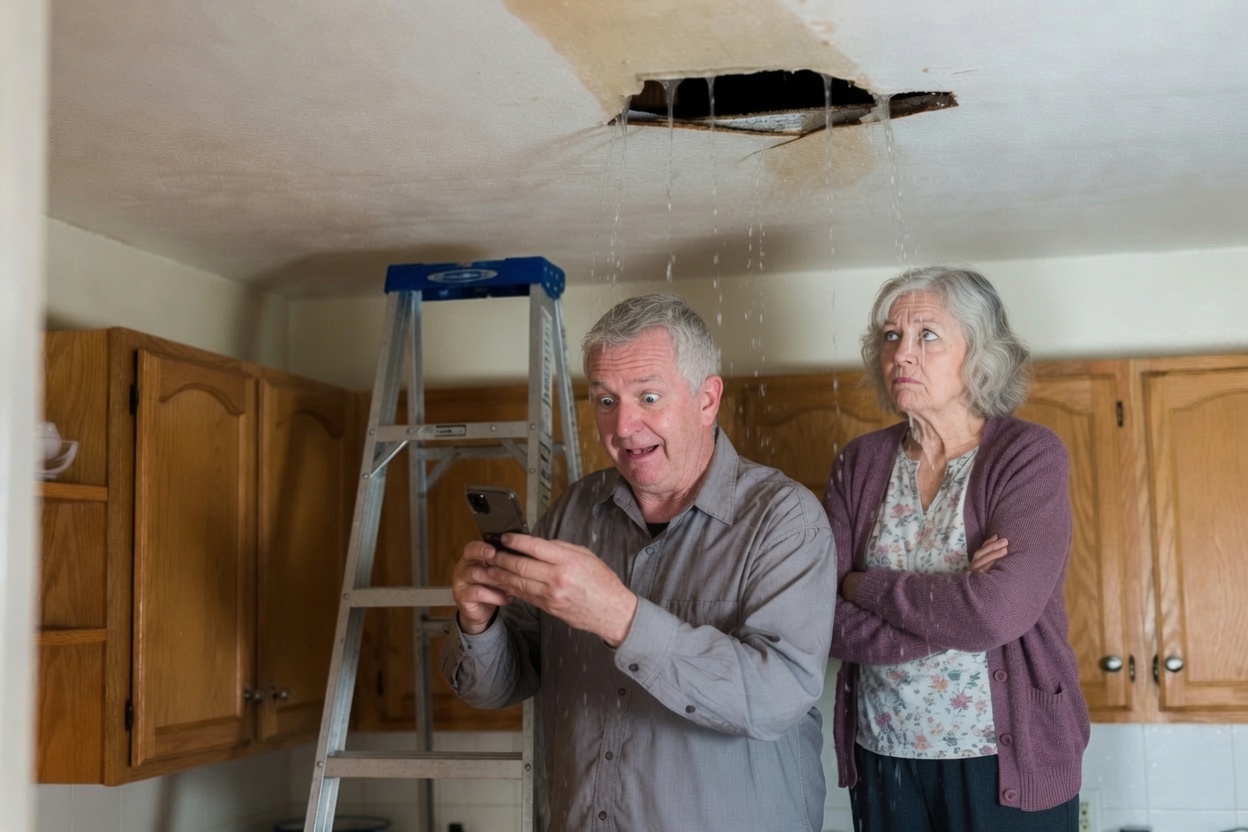
My wife wanted me to remember to call the roofer. Not a complicated request. She had it in her calendar; I had it nowhere. So she said, just put it on yours, and I’ll set a reminder, and we’ll both have it.
We have been married a long time. We have raised children, buried parents, moved houses. And we stood in the kitchen for twenty minutes and could not do this one thing.
Her calendar is on her phone. Mine is on mine. They are not the same calendar, and to make them the same calendar — to let her drop a reminder into my day the way she’d hand me a note across the table — one of us has to give up our phone’s “house” and move into the other’s. Or both of us move into a third house, owned by someone else, who would be glad to have us.
There is no note across the table. There is no neutral square foot of ground where she can leave a thing and I can find it, with no one keeping the books.
So the roofer didn’t get called. And my wife looked at me — a man who has spent his working life on exactly this problem, the space between what’s written and what’s wired — and I had nothing to hand her but the phone in my pocket, which would not do the one thing a sticky note does for free.
• • •
I should explain why that stung more than a missed phone call.
I have spent twenty-five years in the space between what’s written and what’s wired — the divide between a thing you can hold and read and a thing the machine can hold and read. I have studied it, taught it, made things inside it. I once worked on a machine built to bridge exactly this. I am not a man who wandered into the kitchen unequipped.
And I lost the calendar fight anyway.
This isn’t an “OK Boomer” thing, the old man who can’t work his phone. I work my phone just fine. It’s that someone who has spent a career on this exact seam, who knows precisely what should be possible, stood in his own kitchen and watched the simple thing refuse to happen. The expertise didn’t help. The wall didn’t care who was standing in front of it.
I have been tired about this for a long time. Not tired of the technology — the technology is astonishing, and I’ll say so before this is over. Rather, I’m tired of the part where it astonishes you and then quietly won’t let you do the one small human thing you asked. That fatigue isn’t defeat. It’s the specific exhaustion of knowing a thing is possible and watching it be withheld.
• • •
Here is the thing I keep coming back to, the thing that makes all of this harder to swallow.
We already solved this. Centuries ago.
It’s called a “Commonplace Book.” If you’ve never kept one, the idea is almost insultingly simple. More than a “daily-minder”, a commonplace book is a blank book you carry, and into it you copy the things worth keeping — a passage from what you’re reading, a line you overheard, your own thought before it gets away, a quote, a recipe, an address. Whatever you’d otherwise lose. You write it down where you can find it again. That’s the whole technology. No categories required, no system to maintain. The order is just the order you lived it in, and you learn your way around it the way you learn your way around a house.
I came to the commonplace book late — through Thomas Jefferson, who ran a continent out of one; through Ben Franklin, who built a self out of one; through Mortimer Adler, who taught a method for reading so that what you took from a book stayed yours. I came to it as a grown man who had spent years trying to build the same thing in software and failing, and I recognized it the instant I saw it. That was it. That was the thing. Someone had made it already, out of paper, and it had been sitting there working the whole time.
A commonplace book asks nothing of you. No account, no password, no model of who you are. You don’t log into it. You open it and it is exactly where you left it, saying exactly what it said. It remembers everything you put in it and bills you for none of it. It is frameless, portable, and yours, and it scaled well enough to help found a country.
What I’d been trying to rebuild in software was that memory book — and what I could never quite get the software to do was reach the meaning that lived in the thing itself. I could see it on the page. The machine couldn’t. Whatever was actually there, the part that made the page worth keeping, stayed on my side of the glass.
So: the bar exists. It has existed for three hundred years. A pencil cleared it.
Now watch every smart, modern, purpose-built tool fail to.
• • •
So let’s go back to the kitchen.
The reason my wife and I couldn’t share a calendar isn’t that the technology can’t do it. The technology does it beautifully. There are agents now that will read your day, move things around, nudge you at the right hour, hand a reminder from one person to another like passing a plate. It works. I’ve watched it work.
It works inside somebody else’s house. That’s the catch.
There are really two houses on offer, and they run on two different deals. I’m generally an Apple guy. But Apple’s house is private — it keeps your business reasonably close but it locks the doors. What’s yours stays in there, and getting it out to someone in a different house is the project nobody enjoys. Then there’s Google’s house, which throws the doors wide open and invites you in for free, because in that house you are not the guest. You’re the meal. The reason the calendar agent works so well there is the same reason I keep my distance: it works because you’ve already agreed to be read, sorted, and sold back to yourself.
I’m not being paranoid about this, I speak from experience. I watched search — the thing that was supposed to find me the truth — slowly turn into a game where the answer I get is the answer someone paid to put in front of me. I know what it is to be a product dressed up as a customer. And I know there’s no one to call if the house decides, for its own reasons, that I don’t get to live there anymore. You can be evicted from the garden. There is no appeal.
You cannot be evicted from a notebook. It has no terms for you to violate. That was the door that paper held open and the calendar quietly closed: not privacy, not convenience — recourse. The plain ability to keep your own things on ground nobody else owns.
• • •
Fine, you say. Then don’t live in their house. Build your own.
I did. Not the local-machine version yet — that’s the next wall — but the first real try: a notebook of my own, made with the AI itself, for no one but me.
I call it my Ideas Basket. It’s exactly what it sounds like — the place every good scrap goes so I can find it again. A passage, a half-formed argument, a phrase I don’t want to lose. The commonplace book, rebuilt for the age in which I actually live, with the machine as my partner in keeping it. No Google in it. No surveillance. No landlord. I did the work — loaded it into every project, made it the thing my whole practice rests on, the memory that’s supposed to carry from one day’s work to the next.
And it forgets.
Not all at once, which would at least let me catch it. It updates unreliably. I add something, and sometimes it’s there tomorrow and sometimes it isn’t, and I can’t always tell which until I go looking and come up empty. I have even written the company that makes the tool a careful note about exactly this. (I am, after all, a man who reports the bug rather than curses it.)
But sit with what’s actually happening, because this is the wall that frightens me more than Google ever did. There is no villain here. Nobody is selling me. Nobody is reading my basket over my shoulder. I built the thing myself, with a tool that was glad to help, for my own private use — and it still isn’t doing the one thing the cheapest paper notebook has always done without being asked: be there in the morning, unchanged, where I left it, where I can find it.
That last part is the whole game. Mortimer Adler — the man who taught reading so that what you took from a book stayed yours and findable — named the function three generations ago. Findability. The thing stays put and you can get it back. A commonplace book kept both halves of that promise with a pencil and a little patience. My purpose-built, AI-partnered, twenty-first-century basket keeps neither reliably. Staying where you left it is worthless if you can’t be sure it stayed. Being findable is worthless if it didn’t.
The commonplace book never forgot. The second brain forgets. And this time I can’t even be angry at a corporation for it — the forgetting is just how the thing is built.
• • •
All right. One door left.
If you can’t trust their house and you can’t trust the basket you built inside it, there’s a purist’s answer waiting, and I want you to know I went and tried it, rather than just grumble from the arm chair.
Bring the whole thing home. Own the machine, own the files, own the model itself. No company’s garden, no unreliable memory in someone else’s cloud — your own intelligence, running on your own hardware, on your own table, answering only to you.
I set up a local AI. A small computer the size of a paperback, a real language model living on it, the whole thing wired so I could talk to it from my phone like texting a friend who happened to live in my house and keep my secrets. No Google. No landlord. No eviction. The unwalled thing, finally, sitting right there on the desk.
And it ran. That’s the part I want to be clear about — it worked. I’m not reporting a failure of engineering.
I’m reporting a different thing, and it’s harder to admit because it’s about me. The machine was too frameless for me right now. It will do almost anything, but only if I learn to shape it — and shaping it is not an afternoon’s hobby. It’s a second profession. To make my own private intelligence actually serve my writing life, I would have to become, in effect, the engineer who keeps it running. I’d have to put down the work the tool was supposed to free me to do, and pick up the tools.
And there it is. The only escape from every wall is a door that opens onto a whole second career I never asked for and don’t want. I came to all this with one vocation already — the writing, the thinking, the long divide I’ve spent my life inside. The walled gardens want to eat me. The basket forgets me. And the one road out of both — demands I stop being the writer and become the mechanic instead.
In short, you can get to where you want to be by becoming someone else, which isn’t where you want to be.
• • •
So here are the three walls:
The commonplace book was frameless, and it was mine. Every tool that came to improve on it improved one thing and charged me a frame in return. Google improved sharing and charged me surveillance. The basket improved partnership and charged me a memory I can’t trust. The home machine improved freedom and charged me a second life as its engineer. The frameless tool was the one I started with. Every upgrade since has been a frame I didn’t ask for and can’t take off.
This is not a complaint but an indictment: these walls are not growing pains. They are not the rough early version of something that gets smooth in a year or two. The wall is the product. The closed garden, the forgetting, the demand that you become an engineer — those aren’t bugs on the way to being fixed. They’re the business and the architecture agreeing, for once, on the same thing: that the one who should bend is you.
A frameless tool is one nobody can own. That’s the whole reason nobody builds one. There’s no business in a notebook that asks nothing and answers only to you — so every “second brain” arrives pre-framed, because the frame is where the money lives.
You’ve seen the demo. The one where you speak and the assistant arranges your whole life — books the thing, moves the meeting, remembers the roofer. It’s real. It works. It works because the demo lives inside one company’s garden, where everything it needs to touch is already owned by the same hands. Your life doesn’t live in one garden. Your life is spread across all of them, and the thing that would actually stitch them together — the plain stitching-together that would let my wife drop a reminder into my day with no one keeping the books — is the one thing no one in the business has any reason to build.
Which is how I’ve come to put it to myself: the facade is cheaper than the substance. A polished surface that works in the showroom costs a company far less than the unglamorous plumbing that would make it work in your actual house. So they build the surface. They always build the surface.
• • •
I want to end with the one thing that does work and it’s why I haven’t walked away.
The machine can hear me now. I don’t mean it obeys — I mean I can put a thing in front of it, a passage, a tangle of half-thoughts, the contents of a day, and it takes them in and helps me make that mish-mosh coherent. What the pros call “active listening.” After twenty-five years on the divide between what I can hold and read and what the machine can hold and read, that gap has finally closed in one place. Inside the one box, on the one screen, it hears me. That is not nothing. That is the thing I spent a career waiting for.
But hearing me is not the same as acting for me.
It can take in what I set before it. It cannot yet carry what it understood across the walls of my actual life — into my wife’s calendar, into a memory that holds till morning, out of the garden and onto open ground. It hears the roofer needs calling. It still can’t be the note across the table.
So that’s where I am. Standing in the kitchen, where I started, with a machine that finally understands me and a door it can’t yet walk through. The understanding is genuine and the door is locked, and I don’t yet know whether anything gets it open.
I’ve been finding out.